Octopus Energy EV Tariffs: The Complete 2026 Guide
If you're driving an electric car and still paying a standard electricity rate to charge it at home, you're almost certainly overpaying. Octopus Energy, the UK's largest energy supplier with around 7.5 million accounts, has built its reputation in large part on a stable of EV-focused tariffs that reward drivers for charging overnight, when electricity is cheapest and greenest.
This guide walks through how Octopus's EV tariffs work in 2026, what they currently cost, how they've changed over the past year, and how to work out whether one is right for your household.
1. Why EV drivers need a dedicated tariff
A standard variable electricity tariff charges you the same rate around the clock. Under the April 2026 Ofgem price cap, that average unit rate sits at roughly 24.67p per kWh for direct debit customers. Charge a typical EV battery on that rate every night and the cost soon adds up.
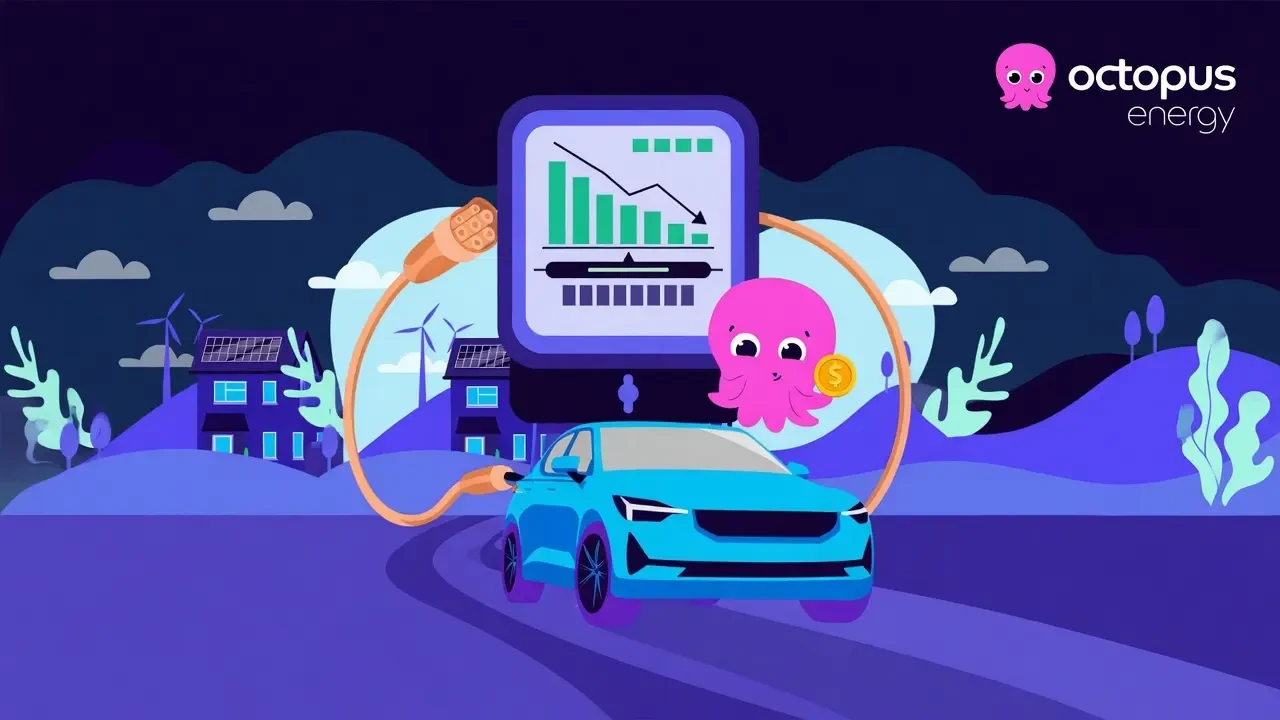
Octopus's EV tariffs flip this model on its head. Instead of one flat rate, you get a deeply discounted overnight rate, in exchange for shifting your car charging (and ideally some of your other household usage) away from the early evening peak. Because EVs typically sit on the drive overnight anyway, this is one of the easiest "behaviour changes" in the entire energy market to make, and the savings are correspondingly large.
2. The two core Octopus EV tariffs
Octopus offers two main products aimed specifically at EV owners: Intelligent Octopus Go and the simpler Octopus Go. Both give you a cheap overnight rate for the whole home, not just your car, but they work quite differently.
Intelligent Octopus Go
This is Octopus's flagship EV tariff and, by most measures, the most popular EV tariff in the UK. It currently offers off-peak charging at 8p per kWh during the hours of 11.30pm to 5.30am, seven days a week. Compared with the average unit rate under the April 2026 price cap of 24.67p per kWh, that represents a saving of around 68% on unit rates alone.
What makes Intelligent Octopus Go different from a simple time-of-use tariff is the smart scheduling layer. You plug your car in, tell the Octopus app how much charge you need, and the system automatically schedules your charging for the half-hour periods when wholesale electricity is expected to be cheapest and greenest. You're guaranteed at least six hours of off-peak pricing for your whole home, and across all the hours your car is plugged in, Octopus may also charge it during additional cheap, often greener, periods at the same off-peak rate.
In practical terms, this means your home gets six guaranteed off-peak hours every night, and whenever Octopus schedules extra smart charging outside that window, the rest of the house benefits from the cheap rate during those scheduled periods too. It's a genuinely "plug in and forget" system: the app handles the timing, and you simply set a target ready-by time.
Real-world savings have been substantial. Octopus reports that, over the year to April 2026, customers on its fixed Intelligent Octopus Go tariff typically saved £771 compared with its standard variable tariff, Flexible Octopus — though Octopus is careful to note that individual savings depend heavily on your overall consumption and how much of it you can shift into the off-peak window.
Octopus Go
Octopus Go is the more traditional, no-frills sibling. It offers a fixed off-peak window of 00:30 to 04:30 — four hours, shorter than Intelligent Octopus Go's six-hour window, and doesn't rely on app-based smart scheduling. This makes it a sensible choice if your car or charger isn't on Octopus's compatibility list, or if you simply prefer a predictable, fixed window without handing scheduling control to an app.
The Octopus Go off-peak rate is slightly higher than Intelligent Octopus Go's, but it's predictable, and standard Go doesn't depend on the Octopus app to work, which suits drivers who want a simple, no-fuss overnight charging routine.
3. What happened to EV tariff rates in 2026?
EV tariff pricing has moved more in the past year than in the several years before it, largely due to government policy changes rather than the wholesale market alone.
The April 2026 cut. From 1 April 2026, Octopus applied government-mandated policy cost reductions to both its EV tariffs, cutting off-peak rates by up to 39%. On Intelligent Octopus Go, the off-peak rate fell from 9p to 5.49p per kWh in some regions — a 39% reduction — while on Octopus Go, the night rate dropped from 10.5p to 6.99p per kWh, a 33% cut. These reductions stemmed from the UK government's November 2025 Budget decision to strip around £150 of green levy costs out of household energy bills, combined with Ofgem's roughly 7% (around £117) cut to the April 2026 price cap for a typical dual-fuel home. Because Octopus prices its tariffs across 14 separate distribution network operator regions, the exact saving varies by area — some regions saw off-peak rates fall below 4p per kWh, while others landed in the 5.49p to 6.99p range.
A correction in April. That initial drop didn't last in its purest form. Shortly afterwards, Octopus told customers that the off-peak unit rate on Intelligent Octopus Go was rising again, citing ongoing global volatility linked to conflict in the Middle East, with standing charges also increasing by around 52p a month on average. Many customers were frustrated by the short notice, especially so soon after rates had just been cut — a reminder that Octopus reviews variable Intelligent Octopus Go pricing roughly every three months, so rates aren't fixed for the life of the tariff on the variable product.
Where things stand now. As of June 2026, the headline picture is: Intelligent Octopus Go offers around 7p per kWh in a smart, six-hour overnight window — generally regarded as the cheapest EV off-peak unit rate on the market. Some sources quote the rate slightly differently depending on region and whether they're describing the fixed or variable product, so it's worth checking the live rate for your own postcode rather than relying on a single national figure, since rates vary by region and change over time.
On the daytime side, peak rates remain the main trade-off. Intelligent Octopus Go's peak rate of around 33.72p per kWh is higher than the daytime rates offered by some rivals such as EDF and E.ON Next, so households that use a lot of electricity during the day should weigh this up carefully.
The wider backdrop. The broader Ofgem price cap is rising by around 13% from 1 July 2026, a rise confirmed on 27 May 2026 — which, if anything, makes the gap between standard tariffs and EV off-peak rates even more pronounced for anyone who can shift their charging overnight.
4. Eligibility and compatible equipment
Both Octopus EV tariffs require a smart meter capable of half-hourly readings, since this is how Octopus distinguishes your off-peak usage from your peak usage.
Intelligent Octopus Go goes a step further: to unlock the automatic smart-scheduling feature, you need a compatible electric vehicle or smart charger that can communicate with the Octopus app. Compatible chargers include the Ohme Home Pro, Ohme ePod, VCHRGD Seven and Seven Pro, Zappi Glo and V1, Hypervolt Home 3 Pro, Indra Smart Pro and Smart Lux, and the Andersen Quartz and A3, alongside a long list of supported EV models. Octopus says Intelligent Octopus Go is compatible with over 280 electric vehicles and most major smart chargers, and the list is updated regularly, so it's worth checking again even if your setup wasn't supported when you last looked.
If your car or charger isn't compatible, Octopus Go remains a straightforward alternative: it still requires a smart meter, but doesn't rely on app-based automation, just a fixed overnight window during which both your car and the rest of your home benefit from the cheaper rate.
5. How Intelligent Octopus Go compares with the rest of the market
Octopus is consistently one of the cheapest and most prominent names in the EV tariff space, but it isn't automatically the best choice for every household. At one point, EDF's lowest EV tariff offered an off-peak rate of 6.49p per kWh, undercutting Octopus on the headline figure, though EV tariff pricing across the market moves frequently and EDF's current rate should be checked independently.
More importantly, EV tariffs across the market now differ not just on price but on how they bill your home. Some suppliers give your whole house a simple overnight window; others extend the cheap rate to the whole home only during scheduled smart-charging sessions; and some leave your general household tariff untouched and apply a separate discount purely to EV charging. E.ON Next's Drive Smart tariff, for example, gives the whole home a cheap overnight window and is said to extend the same smart-charge rate across the home during app-scheduled daytime charging too. The takeaway is the same as it's always been: compare the full shape of the tariff — off-peak rate, peak rate, window length, standing charge and billing model — rather than a single headline number.
6. Beyond charging: other Octopus tariffs worth knowing about
If your household setup goes beyond "just an EV", a couple of other Octopus products are worth a mention:
- Octopus Cosy is aimed at heat pump owners rather than EV drivers specifically, offering off-peak pricing across three daily windows (typically 04:00–07:00, 13:00–16:00 and 22:00–00:00) at around 13p per kWh — useful if your household has both an EV and a heat pump.
- Octopus Flux and Intelligent Flux are export-focused tariffs for households with solar panels and home batteries, with variable export rates and an Intelligent Flux peak export rate reported at up to 32.17p per kWh — relevant if your EV shares a fuse board with solar generation and battery storage.
- Electroverse, Octopus's public charging network card, gives access to a large network of public chargers — useful for topping up away from home on the same account.
7. Working out your potential savings
To get a feel for the numbers, consider a driver covering a typical UK annual mileage who needs somewhere in the region of 2,500–3,000 kWh of electricity a year for charging.
- On a standard variable tariff at around 24.67p per kWh, that's roughly £620–£740 a year just for the electricity to charge the car.
- On Intelligent Octopus Go at around 7–8p per kWh for charging that falls within the smart-scheduled window, the same usage could cost in the region of £175–£240 a year.
That's a saving of several hundred pounds a year on car charging alone — before accounting for any extra savings from shifting dishwasher, washing machine or tumble dryer use into the same overnight window, where the whole-home off-peak rate applies on both Octopus EV tariffs.
8. How to switch to an Octopus EV tariff
- Check your current setup. Confirm you have, or are due to receive, a smart meter, and check whether your car or charger appears on Octopus's compatibility list for Intelligent Octopus Go.
- Get a personalised quote. Octopus lets you enter your postcode and current usage to see the specific off-peak and peak rates available in your area, since rates vary by region.
- Choose between Intelligent Go and Go. If your setup is compatible and you're happy for the app to manage scheduling, Intelligent Octopus Go will usually offer the lowest effective rate. If not, Octopus Go's simple fixed window is a solid fallback.
- Sign up online. The switch is handled for you, typically completing within about five working days, with a smart meter installed or upgraded first if you don't already have one.
- Set your charging preferences. Once live, use the Octopus app to tell it when you need your car ready, and let the smart scheduling do the rest.
9. Frequently asked questions
What is the current Intelligent Octopus Go off-peak rate?
As of mid-2026, Octopus quotes rates in the region of 7–8p per kWh for the smart overnight window, though the exact figure depends on your region and whether you're on the fixed or variable product, and it has moved more than once already this year. Always check the live rate for your postcode before switching.
Do I need a specific car or charger to get the cheap rate?
For Intelligent Octopus Go, yes — you need a compatible EV or smart charger so the app can manage scheduling. Octopus Go doesn't require this and works with a simple fixed overnight window instead.
Will Octopus's rates keep changing?
Quite possibly. Variable Intelligent Octopus Go pricing is reviewed roughly every three months, and 2026 has already seen both a significant cut (from policy changes in April) and a subsequent rise (linked to wholesale market volatility). Fixed-rate versions offer more price certainty for the length of the contract.
Is Octopus automatically the cheapest EV tariff?
Usually competitive, but not guaranteed to be the cheapest for every driver. Rivals such as EDF and E.ON Next have, at various points, offered comparable or lower headline rates, and the best choice depends on your mileage, charging pattern, region, and whether you have solar panels or a home battery. It's worth comparing the whole market before committing.
Does the cheap rate apply to the rest of my home, or just the car?
On both Intelligent Octopus Go and Octopus Go, the off-peak rate applies to your whole home during the guaranteed overnight window — not just your EV charger — so shifting other appliance use into that window adds to your overall savings.